
ADHD and Grief: Mourning the Years Before You Understood Your Own Brain
By Salvatore Barbera, Author of The ADHD Made Gentle Workbook Series
This grief does not always look like the kind most people recognize. There is no funeral for it, no ritual, no clear occasion that gives other people permission to ask if you are okay. It is the quiet mourning of years spent believing a false story about yourself, of support that could have existed and did not, of a version of your life that might have unfolded differently with the right understanding in place sooner. If you have felt this particular grief since learning more about your ADHD, it is real, it deserves space, and this article is about naming it honestly.
Why This Counts as Real Grief
Grief is not reserved exclusively for the death of a person. It is a genuine, appropriate response to real loss, and the losses tied to a late understanding of your own ADHD are real, even though they are harder to point to than a single event. Lost opportunities that a different kind of support might have opened up. Relationships strained by a pattern that had no name and no explanation at the time. Years of internalized shame built on a story about your character that turned out to be inaccurate.
This grief often gets minimized, by others and by the person experiencing it, precisely because it does not fit the more recognizable shape of loss. There was no single moment, no clear before and after, just a slow accumulation of missing context across years. That diffuse quality does not make the grief less real. It just makes it harder to point to and easier for both the person feeling it and the people around them to underestimate.
Grief Closes the Circle on Emotional Regulation
If you have been working through the shame spiral, anger, perfectionism, people-pleasing, and the other patterns that shape ADHD emotional life, grief is the piece that sits underneath much of it. A great deal of shame, perfectionism, and people-pleasing traces back to years of correction that grief, once named, helps put into proper context. The false story that fueled those patterns was never accurate, and mourning the years it went unquestioned is part of what allows a truer, kinder story to actually take its place.
This does not mean grief has to be fully resolved before the other tools become useful. It means the two work together. The practical tools help with the moment-to-moment patterns, while the grief work addresses the deeper story those patterns were often built on top of. Doing both, rather than treating grief as an optional extra step after the real work is done, tends to produce a more complete and more durable kind of change.
What This Grief Often Includes
Grief for the Misunderstood Child or Teenager
Mourning the version of yourself who was corrected, criticized, or punished for behavior that was never actually a choice, and who had no way to explain what was really happening, because neither you nor the adults around you had the language for it yet.
Grief for Support That Never Arrived
Mourning the accommodations, understanding, or simple patience that could have existed if the right information had been available sooner, and that instead simply did not happen, not because anyone was cruel, but because the picture was incomplete.
Grief for the False Story You Believed
Mourning the years spent genuinely believing you were lazy, careless, or simply not trying hard enough, a story that shaped real decisions and real self-treatment, and that turned out to be built on missing information rather than an accurate account of who you actually were.
Grief for an Imagined Different Path
Mourning a version of your life that might have unfolded differently with earlier understanding and support, even while knowing that path can never actually be confirmed or lived, only imagined.
📥 FREE DOWNLOAD: The 15-Minute ADHD Reset Template
Grief does not need to be fully resolved before you are allowed small, structured moments of support in your current life. This free one-page tool gives you a simple, no-shame way to take one small step forward, even while the grief is still present alongside it.
Download it free when you join The Gentle Brain, a newsletter for adults with ADHD who are done blaming themselves and ready for tools that actually fit their brain.
[ JOIN THE GENTLE BRAIN AND GET YOUR FREE TEMPLATE ] → adhdmadegentle.com/newsletter

Holding This Grief Without Rushing Past It
Let It Be Grief, Not Just Reflection
Naming this experience as grief, rather than simply thinking about the past, gives it the weight it actually deserves. Grief is allowed to include anger, sadness, and a genuine mourning process, not just calm, philosophical reflection on what happened.
Resist the Pressure to Only Feel Grateful
A late understanding of your ADHD can bring genuine relief alongside the grief, and there is often real pressure, from others and from yourself, to focus only on the grateful, relieved part of the experience. Both feelings are allowed to exist together, and neither cancels the other out.
Grieve the Story, Not Just the Years
Part of what needs mourning is not simply lost time, but the false story that filled the gap where accurate understanding should have been. Explicitly naming that story as inaccurate, rather than simply moving past it, is part of what allows the grief to actually resolve rather than lingering in the background indefinitely.
Let the Grief Have No Fixed Timeline
This grief does not follow a predictable schedule, and it may resurface unexpectedly long after you thought it had settled, triggered by something as small as an old photograph or an offhand comment. That resurfacing is not evidence of failing to process it correctly. It is simply what integrating a significant loss over time actually looks like.
What This Looks Like in Real Life
Whitney and Naming It as Grief
Whitney spent months after her diagnosis feeling vaguely unsettled without understanding why, since nothing bad had technically happened, quite the opposite. Naming the feeling explicitly as grief, rather than simply confusion or an adjustment period, gave her permission to actually sit with it instead of rushing toward gratitude she was not yet ready to feel.
Devon and Holding Both Feelings
Devon felt genuine relief at his diagnosis and real anger at how long it took to arrive, and initially believed he needed to choose one feeling as the correct response. Learning that both could coexist without canceling each other out let him stop suppressing the anger in favor of a gratitude he had not actually earned yet.
Priya and the Unexpected Resurfacing
Priya thought she had processed her grief about her late diagnosis, until an old school report card surfaced during a move and the feeling returned with surprising intensity. Understanding that grief does not follow a fixed timeline helped her meet that resurfacing without concluding she had failed to process it properly the first time.
💡 Pro Tip: Grief for the years before understanding is real grief, not just reflection. It deserves the same room to exist, including anger and sadness, that any other significant loss would be given.
This Grief Deserves a Name and Some Room
If you take one thing from this, let it be that the quiet mourning you may feel about years spent without understanding your own brain is a legitimate grief, not an overreaction to something that technically turned out fine. The losses were real, even without a single clear event marking them, and they deserve the same acknowledgment any other real loss would receive.
Your brain is differently wired, and different is not defective, and that truth does not erase the real cost of the years before you had the words for it. You do not need to rush toward gratitude before you have given the grief its actual room. The next time this particular sadness resurfaces, unexpectedly or otherwise, you do not have to treat it as a setback or a failure to have moved on. You can let it be grief, hold it alongside whatever relief you also genuinely feel, and trust that both are allowed to be true at once.
📌 Try This Today: Write down one thing you are genuinely grieving about the years before you understood your ADHD, a relationship, an opportunity, a false story you believed about yourself. Let yourself sit with it as real grief, without immediately reaching for the silver lining.
Related reading: The ADHD Made Gentle series continues with new articles every Monday and Thursday.
Ready to Go Deeper?
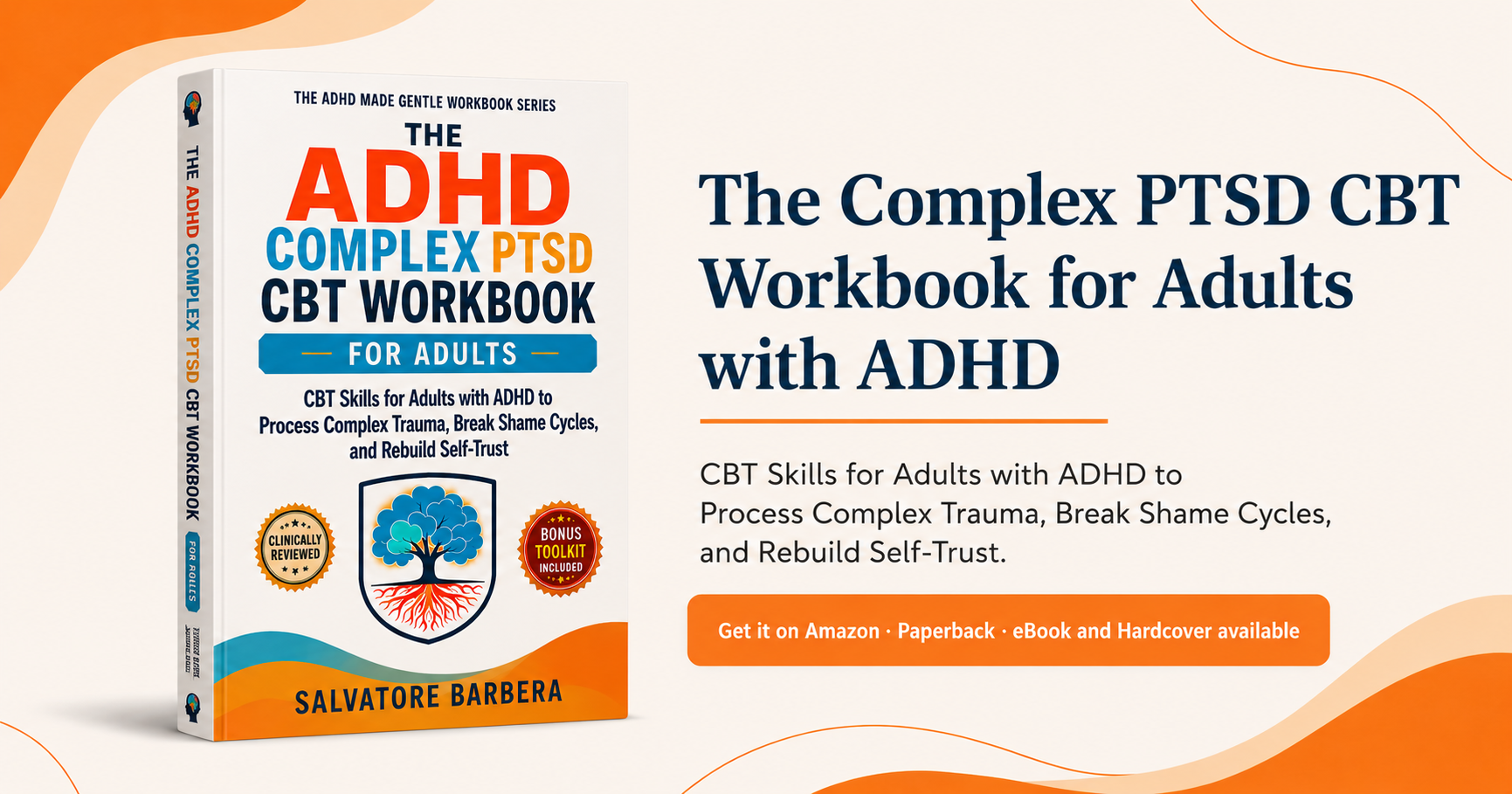
If this is familiar, The ADHD Complex PTSD CBT Workbook for Adults brings together ADHD and trauma-informed tools for the moments when an old feeling takes over, built for nervous systems holding both at once.
Get your copy on Amazon: https://www.amazon.com/dp/B0HDBNDYSP?maas=maas_adg_F46AC7A8D7631B84E890277035859FAC_afap_abs&ref_=aa_maas&tag=maas
Available in paperback, eBook, and hardcover.
Want the Full Toolkit?
The Omni Edition bundles this book with the 3-in-1 CBT, DBT & ACT Workbook and the RSD Workbook in one collection, at a better price than buying them separately.
Get the Omni Edition on Amazon: https://www.amazon.com/dp/B0HKD72RDH?maas=maas_adg_189ADF226D65BFC77BCEFDCB6C98BEB6_afap_abs&ref_=aa_maas&tag=maas

Join the Gentle Brain Press Substack
I publish a new free article here every week. If you want more, the paid tier includes weekly book chapters serialized from these same workbooks, a new tool twice a month, and a monthly Behind the Brain Q&A.
Subscribe at ADHD Made Gentle on Substack: https://adhdmadegentle.substack.com/