ADHD and Burnout: When Pushing Through Finally Stops Working
By Salvatore Barbera, Author of The ADHD Made Gentle Workbook Series
For a long time, pushing through worked. Not comfortably, not sustainably, but it worked, enough caffeine, enough deadline pressure, enough sheer force of will to get through whatever needed getting through. And then, at some point, it simply stopped. The same strategies that used to produce results now produce nothing, just a heavy, immovable exhaustion that does not respond to rest the way ordinary tiredness does. If you have hit this wall, you are not lazy and you have not suddenly lost your work ethic. You are describing ADHD burnout, a specific, recognizable state with its own real mechanics.
Why ADHD Burnout Is Different From Ordinary Tiredness
Ordinary tiredness resolves with rest. A good night of sleep, a restful weekend, and the depletion largely clears. ADHD burnout does not resolve this simply, because it is not primarily about a lack of sleep. It is the accumulated cost of running a brain that requires more compensatory effort than most systems account for, sustained over months or years, without the recovery ever quite catching up to the ongoing cost.
Masking, overcompensating for executive function differences, and constantly working harder than peers to produce comparable results all draw on real, finite resources. When that extra effort runs continuously without genuine recovery, the result is not simple fatigue. It is a deeper depletion that behaves differently, resists ordinary rest, and often comes with a specific, disorienting loss of capacity in areas that used to feel manageable.
Burnout Is Not the Same as Depression, Even Though They Can Overlap
It is worth naming this distinction, since the two often get confused and sometimes coexist. Burnout is fundamentally a depletion of resources caused by sustained, excessive demand relative to available support and recovery. Depression is a distinct clinical condition with its own separate causes and its own treatment approaches. A person can experience burnout without depression, depression without burnout, or both together, and the interventions that help one do not automatically address the other.
This matters practically because burnout responds well to reducing load and increasing recovery, while depression often requires a different kind of support entirely, sometimes including professional treatment that addressing workload alone will not replace. If burnout recovery strategies are not producing improvement after a genuine, sustained attempt, it is worth considering whether depression may also be present, and whether additional support beyond load reduction might be needed alongside it.
Recognizing ADHD Burnout
Skills That Used to Work Suddenly Do Not
Compensatory strategies that reliably got you through in the past, coffee, deadline pressure, sheer willpower, stop producing the same results. This is often the first, most confusing sign, since it can feel like something has gone wrong with your capability itself rather than with your reserves.
Rest Does Not Restore the Way It Used To
A weekend off, or even a longer break, fails to produce the recovery it once did. This is one of the clearest signals that ordinary tiredness has crossed into something deeper, since ordinary tiredness reliably responds to rest in a way burnout does not.
Emotional Regulation Gets Noticeably Harder
An already-taxed system has less capacity left for managing emotional intensity, so reactions that used to be manageable start to feel disproportionately large, and recovery from them takes noticeably longer than it used to.
Tasks That Were Never Hard Before Suddenly Are
Simple, previously automatic tasks, replying to a routine message, making a small decision, can suddenly require an amount of effort that feels wildly out of proportion to the task itself, a clear sign the underlying reserves that used to make those tasks easy have been significantly depleted.
📥 FREE DOWNLOAD: The 15-Minute ADHD Reset Template
Recovering from burnout does not start with a dramatic overhaul. It starts with small, structured permission to do less. This free one-page tool gives you a simple, no-shame way to do just fifteen minutes on a day when a full day feels genuinely out of reach.
Download it free when you join The Gentle Brain, a newsletter for adults with ADHD who are done blaming themselves and ready for tools that actually fit their brain.
[ JOIN THE GENTLE BRAIN AND GET YOUR FREE TEMPLATE ] → adhdmadegentle.com/newsletter

Recovering From ADHD Burnout
Reduce the Masking Load Wherever Possible
Since masking is one of the largest hidden contributors to burnout, finding places, even a few, where the mask can come down at least partially is not a luxury during recovery. It is one of the most direct ways to reduce the ongoing drain that produced the burnout in the first place.
Lower the Bar Temporarily, on Purpose
Burnout recovery is not the time to hold yourself to the same standards that were sustainable before the depletion happened. Deliberately lowering expectations for a defined period, rather than continuing to measure yourself against a pre-burnout baseline, gives the actual recovery room to happen.
Rest in a Way That Matches the Actual Depletion
Passive rest alone does not always address ADHD burnout, since a lot of the depletion is specifically about executive function and masking capacity rather than pure physical fatigue. Reducing decision load, simplifying choices, and removing demands on executive function specifically tends to help more than rest alone.
Expect the Recovery to Take Real Time
ADHD burnout accumulated over months or years does not resolve in a single weekend, and expecting it to often leads to disappointment and a sense of failure when a short break does not produce the hoped-for reset. A longer, more patient recovery timeline is not a sign of weakness. It matches the actual scale of what accumulated.
What This Looks Like in Real Life
Theo and the Coffee That Stopped Working
Theo had relied on caffeine and deadline pressure to push through for years, and was genuinely alarmed when neither produced the same results anymore. Recognizing this as burnout rather than a personal failing let him stop trying to force the old strategies harder, and start actually reducing his load instead.
Amara and the Unrestorative Weekend
Amara took a full weekend off expecting to feel recovered by Monday, and was disoriented when the exhaustion remained essentially unchanged. Understanding that ADHD burnout does not resolve on the same timeline as ordinary tiredness helped her stop blaming the weekend for not working, and start planning for a longer recovery instead.
Devon and the Lowered Bar
Devon kept trying to maintain his pre-burnout standards throughout his recovery, which only deepened the depletion further. Deliberately lowering his expectations for a defined stretch of weeks, treating it as a temporary and necessary adjustment rather than a permanent decline, gave his actual recovery the room it needed to happen.
Farrah and the Overlap With Depression
Farrah initially treated her exhaustion purely as burnout and focused entirely on reducing her workload, without much improvement over several months. A conversation with a doctor surfaced that depression was also present, and addressing both together, rather than assuming workload reduction alone would resolve everything, finally produced the improvement neither approach had managed on its own.
💡 Pro Tip: ADHD burnout does not resolve on the same timeline as ordinary tiredness, because it was never caused by ordinary tiredness in the first place. Recovery requires reducing the actual load, not just resting from it.
You Did Not Suddenly Lose Your Capability
If you take one thing from this, let it be that hitting a wall after years of pushing through is not evidence you have suddenly become lazy or lost your work ethic. It is the predictable result of running a brain that required more compensatory effort than most systems accounted for, sustained for far longer than recovery ever kept pace with.
Your brain is differently wired, and different is not defective. You do not need to earn the right to rest by first proving the exhaustion is severe enough. The next time you notice the old strategies have stopped working and rest is not restoring you the way it used to, you do not have to keep pushing harder against a wall that pushing built in the first place. You can lower the bar, reduce the mask, and give the recovery the real time it actually needs.
📌 Try This Today: Pick one place today where you can lower the mask, even slightly, or reduce a demand on yourself that is not strictly necessary right now. Notice how it feels to deliberately do less than your usual standard, even temporarily.
Related reading: The ADHD Made Gentle series continues with new articles every Monday and Thursday.
Ready to Go Deeper?
The 3-in-1 ADHD CBT, DBT & ACT Workbook for Adults
Combines three evidence-informed therapy frameworks into one warm, clinically reviewed workbook with ten named tools for the adult ADHD brain, including THE ENERGY LEDGER, for tracking what is actually draining you during recovery, and THE COMPASSIONATE RESTART, a shame-free way back in after burnout, no self-punishment required.
GET YOUR COPY ON AMAZON → (Paperback ASIN B0H6LMYYW8)
Available in paperback, eBook, and hardcover on Amazon.

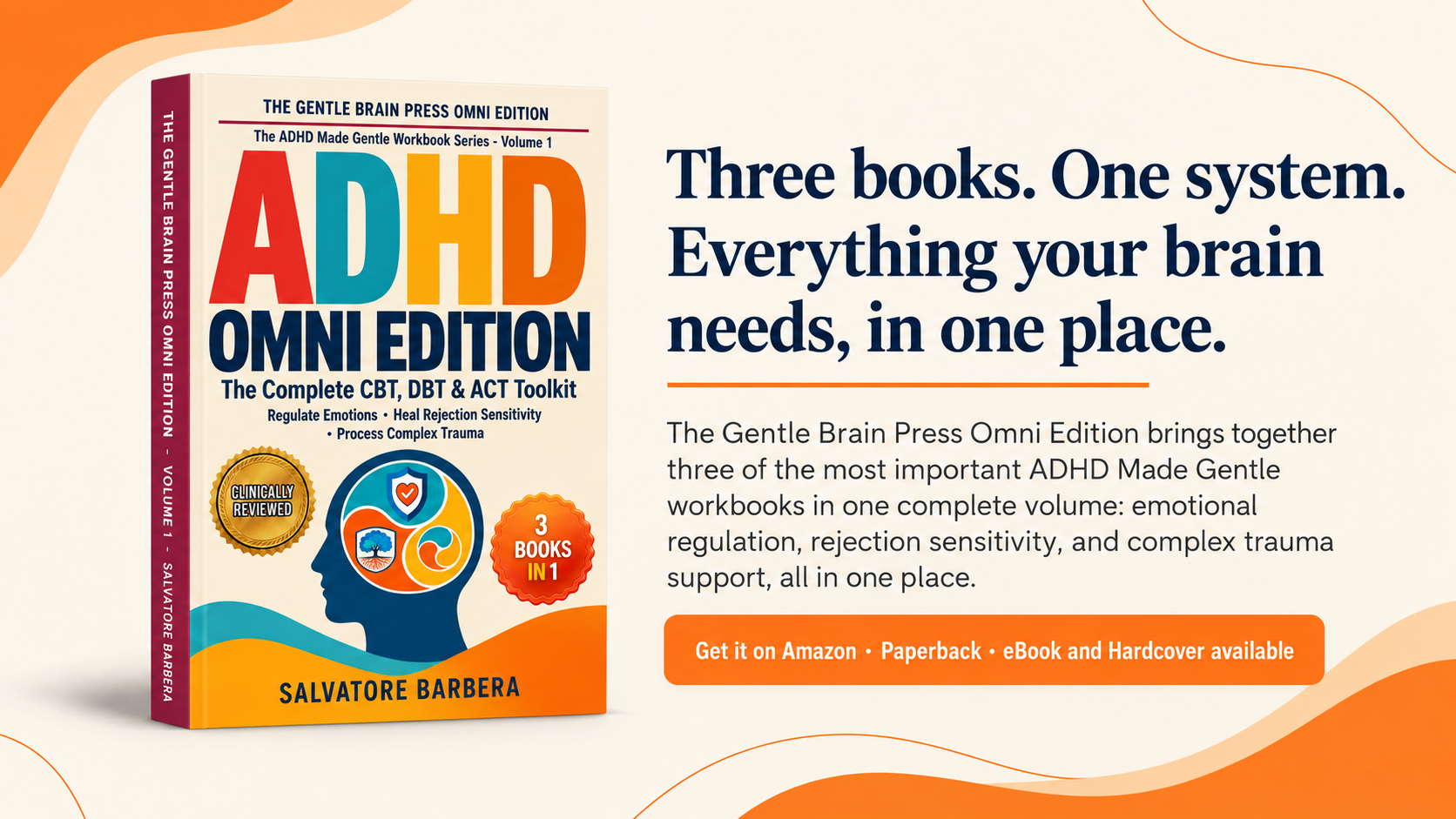
The Gentle Brain Press Omni Edition, The ADHD Made Gentle Workbook Series Volume 1
Three complete workbooks in one premium volume, with every tool, every exercise, and every writing space fully intact. Includes The 3-in-1 ADHD CBT, DBT & ACT Workbook, The RSD Workbook, and The ADHD Complex PTSD CBT Workbook, the most comprehensive CBT, DBT, and ACT resource for the adult ADHD brain currently available in one volume. Clinically reviewed by Musfirah Nasr Chaudhry, MS Clinical Psychology.
GET YOUR COPY ON AMAZON → (Paperback ASIN B0HKD72RDH)
Available in paperback and hardcover on Amazon.
Join the Gentle Brain Press Substack
I publish a new free article here every week. If you want more, the paid tier includes weekly book chapters serialized from these same workbooks, a new tool twice a month, and a monthly Behind the Brain Q&A.
Subscribe at ADHD Made Gentle on Substack: https://adhdmadegentle.substack.com/