
ADHD and Multiple Deadlines: Why Having Several Things Due Feels Like Having None
By Salvatore Barbera, Author of The ADHD Made Gentle Workbook Series
One deadline, you can handle, even if it comes down to the wire. But three deadlines in the same week, none of them the single most urgent thing, somehow adds up to a strange kind of paralysis where none of them get meaningfully worked on at all. If a single pressing deadline can mobilize you but several simultaneous ones seem to cancel each other out into inaction, there is a real, specific reason multiple deadlines behave so differently than one for an ADHD brain.
Why One Deadline Works and Three Do Not
A single, clear deadline provides something an ADHD brain often needs to actually engage: urgency and specificity. There is one thing, one due date, one clear target, and that clarity itself helps organize attention and motivation around it. Multiple deadlines, even when each one individually would be perfectly manageable alone, remove that single clear target and replace it with a genuinely harder problem: which one, right now, and in what order.
This decision itself, prioritizing among several real, valid demands, is its own executive function task, and it is a demanding one. A brain already managing several deadlines' worth of anxiety has less capacity left over for the additional job of ranking them, which means the ranking often simply does not happen, and without it, no single deadline gets the clear, motivating urgency that would help mobilize action on it specifically.
The Paralysis Is Not About Not Caring
It is worth being direct about this, since multiple missed or scrambled deadlines often get read, by others and by the person experiencing it, as evidence of not caring enough or not being organized enough. In reality, the paralysis frequently comes from caring about all of them simultaneously, without a clear mechanism for deciding which one gets the currently limited attention and energy available.
This is a genuinely different problem than indifference, and it requires a different solution. Indifference is addressed by increasing motivation. A prioritization bottleneck is addressed by making the ranking decision explicit and external, rather than expecting it to resolve naturally through willpower or caring harder about the outcome.
Why the Pile Feels Heavier Than the Sum of Its Parts
There is also an emotional dimension worth naming directly. Each individual deadline on a competing list carries its own quiet anxiety, and when several are present at once, those anxieties do not simply add together in a predictable, linear way. They tend to compound, since attention keeps flicking between them, briefly reactivating the worry attached to each one every time focus lands on it, even for a moment, before moving to the next.
This is part of why a pile of three moderately sized deadlines can feel more overwhelming than a single deadline that is objectively larger than any of the three individually. The felt weight is not simply the size of the tasks. It is the compounding cost of repeatedly reactivating anxiety about several things in quick succession, which is exhausting in a way that a single, sustained focus on one large task usually is not.
📥 FREE DOWNLOAD: The 15-Minute ADHD Reset Template
When several deadlines are competing for attention, working in short, defined blocks on just one at a time can break the paralysis faster than trying to solve everything at once. This free one-page tool gives you a simple, structured way to commit to just fifteen minutes on one thing, without needing to resolve the whole competing pile first.
Download it free when you join The Gentle Brain, a newsletter for adults with ADHD who are done blaming themselves and ready for tools that actually fit their brain.
[ JOIN THE GENTLE BRAIN AND GET YOUR FREE TEMPLATE ] → adhdmadegentle.com/newsletter

Practical Ways to Break the Deadlock
Make the Ranking Decision Explicit and Written
Rather than trying to hold the relative priority of several deadlines in your head, where the ranking tends to shift constantly and resolve into nothing, write down an actual, explicit order. The order does not need to be perfect. It needs to exist outside your head, where it can actually be acted on.
Work One at a Time, Fully, Before Switching
Attempting to make simultaneous progress across several deadlines at once usually produces less real progress on any of them than committing to one at a time, in defined blocks, before deliberately switching to the next. This also reduces the task-switching cost that comes with constantly bouncing between competing priorities.
Separate Genuinely Urgent From Merely Present
Not every deadline on the list is equally time-sensitive, even when they all feel that way in the moment. Explicitly checking which ones have real, immediate consequences for lateness versus which ones have more flexibility can meaningfully clarify the ranking exercise once it is made concrete.
Communicate Early If a Deadline Needs to Move
If the honest ranking reveals that something genuinely cannot be met on time, communicating that as early as possible, rather than waiting for the deadline to arrive and then explaining after the fact, tends to produce far better outcomes and far less accumulated dread than silence followed by a late surprise.
What This Looks Like in Real Life
Elena and the Written Ranking
Elena used to freeze completely when three work deadlines landed in the same week, unable to decide where to even start. Writing an explicit, if imperfect, ranking on paper broke the freeze almost immediately, since the decision no longer needed to be made and remade constantly inside her head.
Marcus and the One-at-a-Time Rule
Marcus used to bounce between several half-finished projects when multiple deadlines converged, making shallow progress on all of them and finishing none. Committing to one project per defined block, deliberately ignoring the others until the block ended, produced noticeably more real progress than trying to split attention across all of them simultaneously.
Priya and the Early Communication
Priya used to stay silent about a deadline she knew she would miss until the day arrived, producing a scramble and an awkward explanation after the fact. Once she started flagging a likely delay as soon as she recognized it, rather than waiting for the deadline itself, the conversations became noticeably easier and the consequences noticeably smaller.
Devon and the Compounding Weight
Devon used to describe three moderate deadlines as somehow feeling worse than one large project he had handled the month before, and could not explain why until he understood the compounding effect of switching attention repeatedly between several sources of anxiety. Once he named what was actually happening, ranking and working through them one at a time felt less like a personal failure and more like a reasonable response to a genuinely harder situation.
💡 Pro Tip: Multiple deadlines do not cancel each other out because you do not care. They cancel each other out because ranking them is its own demanding task, one that needs to happen explicitly and externally rather than being expected to resolve on its own.
The Freeze Was Never About Caring Less
If you take one thing from this, let it be that freezing when faced with several competing deadlines is not evidence you do not care enough about any of them. It is evidence that prioritizing among several real demands is its own genuine executive function task, one that gets harder, not easier, the more your existing capacity is already being spent managing the anxiety of having several things due at once.
Your brain is differently wired, and different is not defective. You do not need to somehow rank your priorities perfectly in your head before you are allowed to make progress on any of them. The next time several deadlines converge and you feel the familiar paralysis setting in, you do not have to keep trying to resolve the ranking silently. You can write it down, commit to one at a time, and let real progress on something replace the frozen attempt to solve everything simultaneously.
📌 Try This Today: If you currently have more than one deadline competing for your attention, write down an explicit ranking right now, even an imperfect one. Then commit to fifteen minutes on whichever one is ranked first, and only that one.
Related reading: The ADHD Made Gentle series continues with new articles every Monday and Thursday.
Ready to Go Deeper?
If this is familiar, The ADHD Complex PTSD CBT Workbook for Adults brings together ADHD and trauma-informed tools for the moments when an old feeling takes over, built for nervous systems holding both at once.
Get your copy on Amazon: https://www.amazon.com/dp/B0HDBNDYSP?maas=maas_adg_F46AC7A8D7631B84E890277035859FAC_afap_abs&ref_=aa_maas&tag=maas
Available in paperback, eBook, and hardcover.

Want the Full Toolkit?
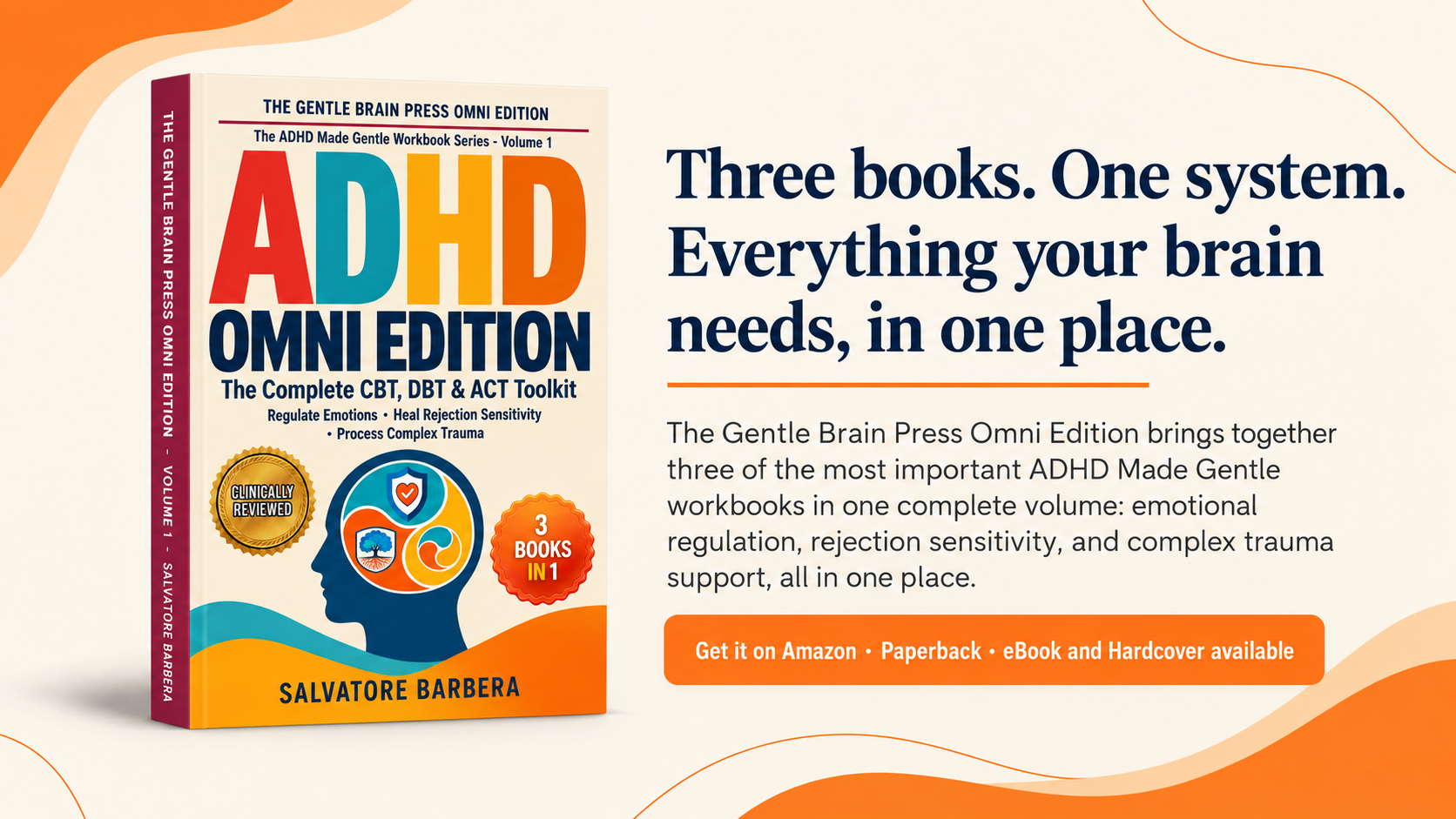
The Omni Edition bundles this book with the 3-in-1 CBT, DBT & ACT Workbook and the RSD Workbook in one collection, at a better price than buying them separately.
Get the Omni Edition on Amazon: https://www.amazon.com/dp/B0HKD72RDH?maas=maas_adg_189ADF226D65BFC77BCEFDCB6C98BEB6_afap_abs&ref_=aa_maas&tag=maas
Join the Gentle Brain Press Substack
I publish a new free article here every week. If you want more, the paid tier includes weekly book chapters serialized from these same workbooks, a new tool twice a month, and a monthly Behind the Brain Q&A.
Subscribe at ADHD Made Gentle on Substack: https://adhdmadegentle.substack.com/