
Emotional Permanence and ADHD: Why Good Feelings Do Not Always Stay Remembered
By Salvatore Barbera, Author of The ADHD Made Gentle Workbook Series
Someone tells you they love you, and in the moment, you believe it completely. A day later, without anything actually changing between you, the certainty has quietly evaporated, replaced by a nagging doubt that feels just as real as the original certainty did. If good feelings about a relationship, an achievement, or even your own worth seem to fade from memory faster than they should, there is a real, specific reason, and it has a name: emotional permanence, and it works differently for a lot of ADHD adults.
What Emotional Permanence Actually Means
Emotional permanence is the ability to hold onto the felt sense of a relationship, an accomplishment, or a positive belief about yourself even when you are not actively experiencing evidence of it in the present moment. Someone with strong emotional permanence can feel loved even during a day without contact from the person who loves them, because the memory and feeling stay accessible even when nothing new is currently reinforcing it.
For a lot of ADHD adults, this permanence is less reliable. The felt sense of being loved, valued, or good at something tends to fade without regular, fresh reinforcement, not because the underlying relationship or achievement has actually changed, but because the emotional memory of it does not stay as consistently accessible in the absence of current evidence.
Why This Connects to ADHD Specifically
This is closely related to object permanence in the classic developmental sense, and it draws on similar working memory processes that ADHD affects more broadly. Just as ADHD can make it hard to keep a task in mind without an external reminder, it can make it hard to keep an emotional state in mind without something currently reinforcing it. The feeling was real. It is simply harder to keep actively present in memory once the original triggering event has passed.
This is not the same as not truly believing something, and it is not evidence of insecurity in the way that term usually gets used. It is closer to a working memory issue applied to emotional states rather than to facts or tasks, and understanding it this way changes how unfairly it tends to get judged, both by other people and by the person experiencing it.
The Overlap With Rejection Sensitivity
Emotional permanence and rejection sensitive dysphoria often compound each other in ways worth understanding clearly. When a positive feeling fades, the resulting uncertainty can feel, to a brain already primed toward rejection sensitivity, like early evidence that something is actually wrong, rather than simply a memory pattern doing what it naturally does. The fade itself becomes a trigger for the very fear it was never actually signaling.
This combination can create a loop that is worth recognizing by name. A feeling fades, which triggers rejection-sensitive anxiety, which produces a need for reassurance, and if that reassurance is not immediately available, the anxiety intensifies further, all without anything having actually changed in the underlying relationship or fact. Recognizing this loop as a specific, nameable pattern, rather than an accurate read of reality, is often the first step to interrupting it before it fully takes hold.
📥 FREE DOWNLOAD: The 15-Minute ADHD Reset Template
Reinforcing an emotional memory benefits from the same kind of small, external structure this tool provides for other unreliable internal signals. This free one-page tool gives you a simple, structured way to build small, regular touchpoints into your day.
Download it free when you join The Gentle Brain, a newsletter for adults with ADHD who are done blaming themselves and ready for tools that actually fit their brain.
[ JOIN THE GENTLE BRAIN AND GET YOUR FREE TEMPLATE ] → adhdmadegentle.com/newsletter

Working With Unreliable Emotional Permanence
Build In Regular, External Reinforcement
Rather than relying on a single positive statement to sustain a feeling indefinitely, small, regular touchpoints, a saved message reread occasionally, a brief regular check-in, help keep an emotional truth accessible without requiring perfect internal memory to hold it alone.
Keep a Concrete Record of Positive Evidence
A saved folder of kind messages, a written list of accomplishments, or specific compliments noted down in the moment they happened creates an external record you can return to when the internal felt sense has faded, even though the underlying fact has not actually changed.
Name the Fade as a Memory Pattern, Not New Evidence
When a previously certain feeling starts to waver without any new negative evidence, naming it explicitly, this is emotional permanence fading, not new information, helps prevent the fade from being mistaken for an actual signal that something has changed.
Ask for Reinforcement Without Shame
If a relationship allows it, asking directly for the kind of reassurance or reminder that helps, rather than assuming it should not be necessary, is a reasonable accommodation rather than something to apologize for constantly needing.
What This Looks Like in Real Life
Sofia and the Saved Messages
Sofia noticed her certainty about being valued at work faded within days of positive feedback, replaced by a nagging doubt that felt equally real. Keeping a saved folder of positive feedback she could reread during a fade gave her something concrete to return to, rather than relying on memory alone to hold the feeling indefinitely.
Marcus and Naming the Pattern
Marcus used to interpret the fading certainty in his relationship as evidence something was actually wrong, which created real anxiety and friction. Learning to name it explicitly as emotional permanence fading, rather than new information, helped him separate the pattern from an actual signal about the relationship's health.
Priya and Asking Directly
Priya used to feel embarrassed about needing more frequent reassurance than she assumed was normal. Once she understood the actual mechanism behind it, she started asking her partner directly for small, regular check-ins, framed as a reasonable accommodation rather than a flaw to apologize for, and the relationship became noticeably easier for both of them.
Dev and the Rejection Sensitivity Loop
Dev noticed his doubt about a friendship would spike sharply whenever a normally responsive friend went a day without replying, even though nothing had actually changed between them. Recognizing this as the specific overlap between fading emotional permanence and rejection sensitivity, rather than a genuine signal, helped him ride out the anxious loop instead of acting on it prematurely.
💡 Pro Tip: A fading feeling is not new evidence that something has changed. It is often simply emotional permanence doing what it does, and a concrete record of positive evidence can hold what memory alone struggles to keep accessible.
The Feeling Fading Does Not Mean It Was Never True
If you take one thing from this, let it be that a positive feeling fading from memory is not evidence the underlying truth has changed. It is a working memory pattern applied to emotional states, and it deserves the same kind of external support you would give any other unreliable internal signal, not shame for needing it.
Your brain is differently wired, and different is not defective. You do not need a perfect, permanent internal record of every good thing before you are allowed support for the memory you actually have. The next time a certainty you once felt strongly starts to waver without any real new evidence, you do not have to treat the fade as truth. You can return to a concrete record, ask for reinforcement, and let the fact remain true even while the felt sense of it comes and goes.
📌 Try This Today: Write down one thing you know to be true about a relationship or accomplishment in your life right now, while the feeling is accessible. Save it somewhere you can find it again, and return to it the next time the certainty starts to fade.
Related reading: The ADHD Made Gentle series continues with new articles every Monday and Thursday.
Ready to Go Deeper?
If this resonated, The 3-in-1 ADHD CBT, DBT & ACT Workbook for Adults gives you therapy-based tools to regulate emotions, build focus, and finally create systems that work with your ADHD brain instead of against it.
Get your copy on Amazon: https://www.amazon.com/dp/B0H6LMYYW8?maas=maas_adg_AFAA69974FEE8BC9F8203E17406AB8EA_afap_abs&ref_=aa_maas&tag=maas
Available in paperback, eBook, and hardcover.

Want the Full Toolkit?
The Omni Edition bundles this book with the RSD Workbook and the Complex PTSD CBT Workbook in one 3-in-1 collection, at a better price than buying them separately.
Get the Omni Edition on Amazon: https://www.amazon.com/dp/B0HKD72RDH?maas=maas_adg_189ADF226D65BFC77BCEFDCB6C98BEB6_afap_abs&ref_=aa_maas&tag=maas
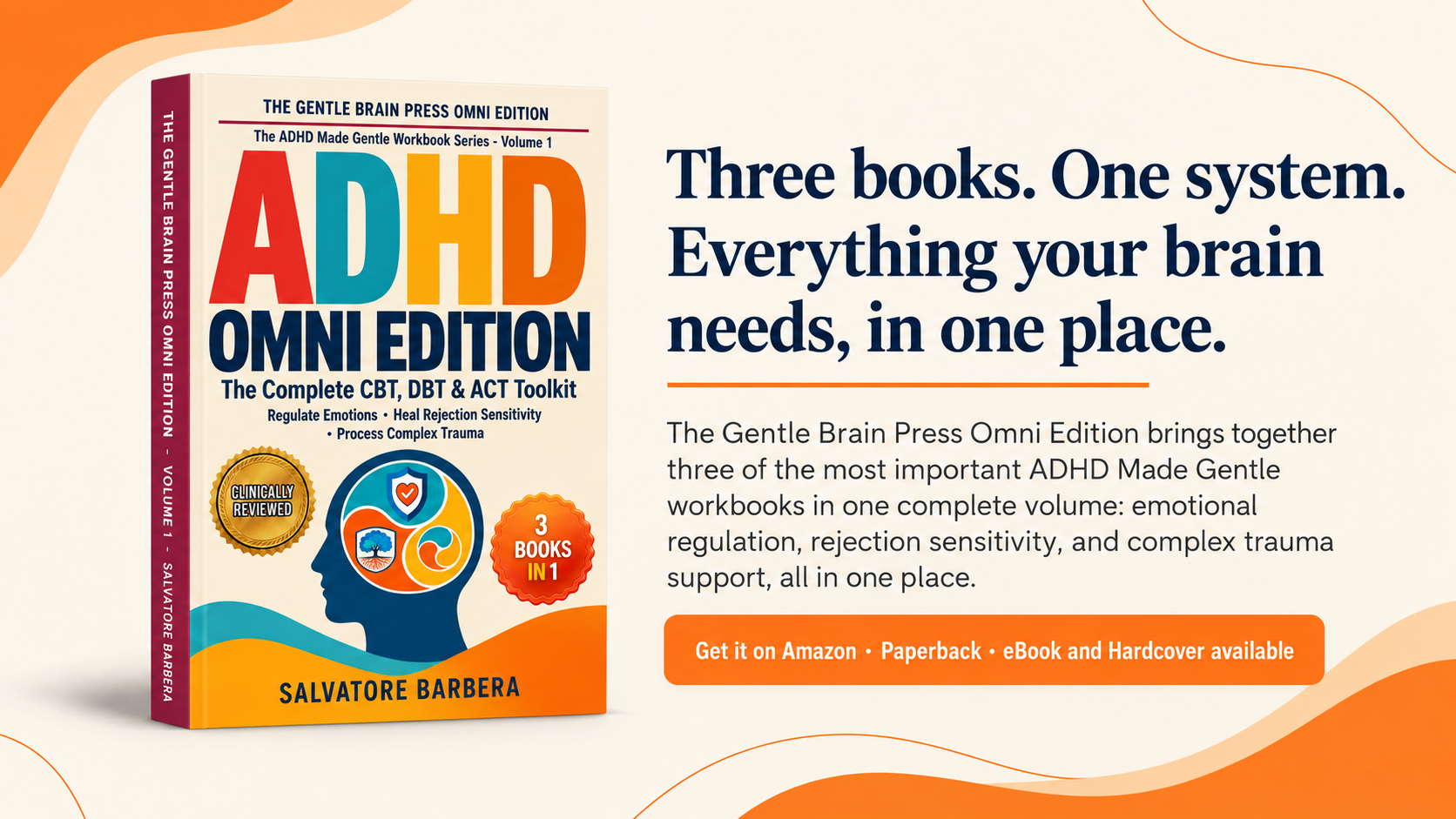
Available in paperback and hardcover.
Join the Gentle Brain Press Substack
I publish a new free article here every week. If you want more, the paid tier includes weekly book chapters serialized from these same workbooks, a new tool twice a month, and a monthly Behind the Brain Q&A.
Subscribe at ADHD Made Gentle on Substack: https://adhdmadegentle.substack.com/