Is ADHD a Disability? What the Answer Actually Depends On
By Salvatore Barbera, Author of The ADHD Made Gentle Workbook Series
It is a genuinely uncomfortable question for a lot of ADHD adults to sit with. On one hand, calling it a disability can feel like an overstatement, especially if you have built a successful career and a functional life despite the struggle it takes. On the other, dismissing that label entirely can feel like erasing the very real, sometimes significant impact ADHD has had on your daily functioning. The honest answer is more nuanced than a simple yes or no, and understanding that nuance is genuinely useful, both for how you think about your own experience and for practical questions like workplace accommodations.
Why This Question Does Not Have One Simple Answer
ADHD is legally and clinically recognized as a disability in many contexts, including under disability rights frameworks in numerous countries, when it substantially limits one or more major life activities. This is not a controversial or fringe classification. It has real legal and practical weight, particularly around workplace accommodations, educational support, and disability protections.
At the same time, the actual functional impact of ADHD varies enormously from person to person, and even within the same person across different periods of their life. Someone whose ADHD is well-supported by the right structures, tools, and environment may experience genuinely minimal functional limitation day to day, while someone in an unsupportive environment with the same underlying condition may experience severe, disabling impact. The condition itself does not change. The functional experience of it depends heavily on the fit between the person and their environment.
The Social Model of Disability Is Useful Here
A helpful framework for thinking about this comes from what is often called the social model of disability, which distinguishes between an underlying condition and the disabling impact that condition has within a specific environment. Under this framework, a person is not simply disabled or not disabled as a fixed, permanent trait. They experience disability to the degree that their environment fails to accommodate the way their body or brain actually works.
Applied to ADHD, this means the same underlying neurological difference can be significantly disabling in one environment, a rigid, unaccommodating workplace with no flexibility, and barely noticeable in another, a role that genuinely fits how an ADHD brain operates best. This does not mean the underlying difference is not real or significant. It means the disabling impact is not solely a property of the brain itself, but of the mismatch between that brain and the demands placed on it.
Different Communities Frame This Differently
It is worth knowing that thoughtful people within ADHD and neurodivergent communities genuinely disagree about how to frame this question, and both perspectives deserve real consideration rather than one being simply correct. Some embrace the disability label directly, sometimes described as disability pride, viewing it as an important, accurate acknowledgment of real struggle that deserves the same recognition and accommodation as more visible disabilities, and pushing back against any implication that claiming the label diminishes a person.
Others prefer to emphasize a neurodiversity framing that focuses primarily on difference rather than disability, arguing that the term disability can carry unintended connotations of deficiency that do not fully capture a brain that is simply wired differently rather than lesser. Neither view is uniformly right or wrong, and reasonable people within the ADHD community land in different places on this question, often for good, well-considered reasons rooted in their own lived experience.
📥 FREE DOWNLOAD: The 15-Minute ADHD Reset Template
Whatever language feels right for your own experience, having small, practical tools available matters regardless of how you personally frame the disability question. This free one-page tool gives you exactly that kind of practical support, useful whether you consider your ADHD disabling, simply different, or somewhere in between.
Download it free when you join The Gentle Brain, a newsletter for adults with ADHD who are done blaming themselves and ready for tools that actually fit their brain.
[ JOIN THE GENTLE BRAIN AND GET YOUR FREE TEMPLATE ] → adhdmadegentle.com/newsletter

What This Means Practically
You Do Not Need to Resolve the Label to Seek Accommodation
Whether or not you personally identify with the word disability, you are still generally entitled to reasonable accommodations in workplaces and educational settings if ADHD substantially affects your ability to perform in that environment. The practical right to accommodation does not depend on your personal comfort with any particular label.
Both Framings Can Be True at Different Times
It is entirely reasonable to feel that ADHD functions as a genuine disability during a particularly unsupportive period of your life, and to feel it functions more as a difference during a well-supported one. Neither framing needs to be permanently, universally true for you across your entire life.
The Label Is a Tool, Not a Verdict
Whichever framing you choose, disability, difference, both, or neither, the choice is a tool for getting support and understanding your experience, not a permanent verdict about your worth or capability. You are allowed to use whichever framing is currently the most useful for the accommodation, understanding, or support you actually need.
Your Own Experience Is the Relevant Data
The legal and clinical definitions provide a useful framework, but your own lived experience of how much ADHD is actually limiting your daily functioning right now is the most relevant data for deciding how you personally want to think and talk about it, regardless of how anyone else frames their own experience.
What This Looks Like in Real Life
Amir and the Workplace Accommodation
Amir had always resisted the word disability, feeling it did not fit his successful career. When a new job's rigid structure started causing real functional struggle, he applied for formal accommodations anyway, without needing to fully resolve his personal feelings about the label first, simply because the practical support was available and useful.
Layla and the Changing Framing
Layla noticed her own relationship to the disability question shifted depending on her circumstances, feeling far more disabled during an unsupportive job than during a later one that genuinely fit how her brain worked. She stopped trying to land on one permanent answer and let the framing shift honestly with her actual experience instead.
Desmond and the Practical Focus
Desmond found the philosophical debate about the label less useful to him personally than simply focusing on what actually helped him function well day to day. Whether or not ADHD technically counted as a disability in his own mind mattered less to him than building the specific structures and tools that reduced his actual daily struggle.
💡 Pro Tip: The disability question does not need one permanent answer. Your own lived experience of how much ADHD is limiting your functioning right now is the most useful data for deciding how to think and talk about it in this particular season.
The Question Is Yours to Answer, and It Can Change
If you take one thing from this, let it be that there is no single correct answer to whether ADHD is a disability, and you are not required to land on one permanently. The functional impact genuinely varies by environment and by season of life, and the label that fits during one period may not fit during another, without either version being wrong.
Your brain is differently wired, and different is not defective, and that remains true regardless of which framing currently fits your experience best. You do not need to resolve this question philosophically before you are allowed to seek the practical support that actually helps you. The next time you find yourself unsure whether your experience counts as significant enough to warrant support or accommodation, you do not have to wait for certainty about the label. You can seek the support based on your actual, current functional experience, and let the framing follow from there.
📌 Try This Today: Notice how your own relationship to the word disability has shifted across different periods of your life, different jobs, different environments. Write down what made ADHD feel more or less limiting during those different times, and notice what that tells you about the actual source of the difficulty.
Related reading: The ADHD Made Gentle series continues with new articles every Monday and Thursday.
Ready to Go Deeper?
If this resonated, The 3-in-1 ADHD CBT, DBT & ACT Workbook for Adults gives you therapy-based tools to regulate emotions, build focus, and finally create systems that work with your ADHD brain instead of against it.
Get your copy on Amazon: https://www.amazon.com/dp/B0H6LMYYW8?maas=maas_adg_AFAA69974FEE8BC9F8203E17406AB8EA_afap_abs&ref_=aa_maas&tag=maas
Available in paperback, eBook, and hardcover.

Want the Full Toolkit?
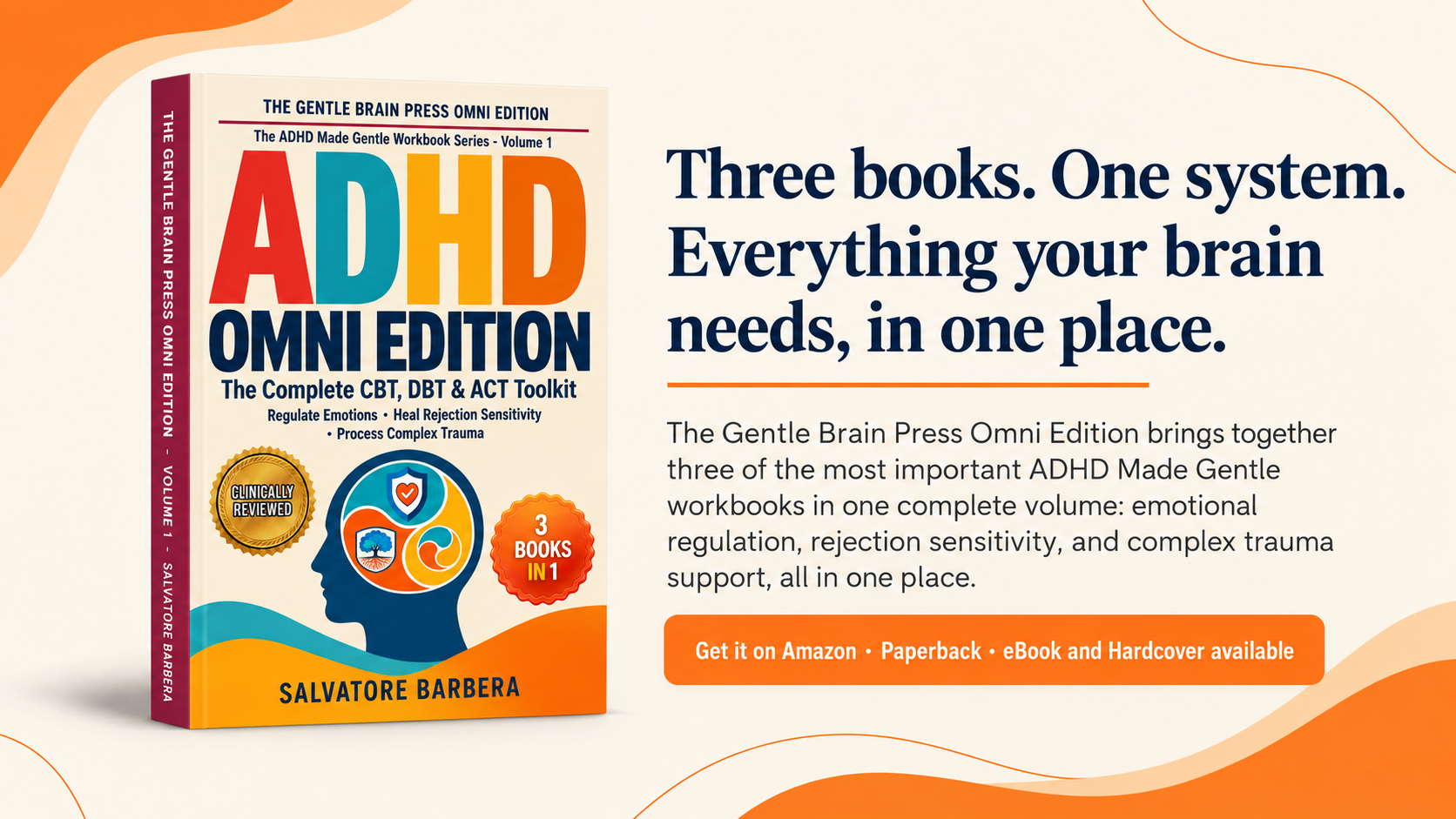
The Omni Edition bundles this book with the RSD Workbook and the Complex PTSD CBT Workbook in one 3-in-1 collection, at a better price than buying them separately.
Get the Omni Edition on Amazon: https://www.amazon.com/dp/B0HKD72RDH?maas=maas_adg_189ADF226D65BFC77BCEFDCB6C98BEB6_afap_abs&ref_=aa_maas&tag=maas
Join the Gentle Brain Press Substack
I publish a new free article here every week. If you want more, the paid tier includes weekly book chapters serialized from these same workbooks, a new tool twice a month, and a monthly Behind the Brain Q&A.
Subscribe at ADHD Made Gentle on Substack: https://adhdmadegentle.substack.com/